Looking & Seeing
contemplations on a theme
Sept 2025 – EVOKE Contemporary – Gallery News. Written by John O’Hern, an arts writer, curator and retired museum director who is providing a weekly contemplation of a single work of art from our gallery. In our fast-paced lives overflowing with information, we find it necessary and satisfying to slow down and take time to look. We hope you enjoy this perspective from John.
The dog days of summer are behind us and, tomorrow, autumn begins. Sirius is the brightest star in the constellation Canis Major (the Greater Dog). The Greeks and Romans thought the conjunction of the sun during the day and Sirius at night caused the sweltering heat of mid-summer.
Thus, today’s theme. . . dogs.
Canis is the Latin word for dog. Canis lupus is the species name for the grey wolf. The subspecies Canis lupus familiaris is the domestic dog, indicating the close evolutionary relationship between the two. But we’ll get to wolves later.
Gugger Petter lived in Mexico for 11 years where she “learned to my great despair that nothing was ever done to help or support any of the millions of stray dogs in this country. To this fact, I decided in 1994 that I would pay tribute to these dogs by creating sculptures in bronze and mixed media. I entitled this group Stray Dogs.
I have since frequently included the dog image in my group of large wall pieces entitled Street Scenes. Here, only the dog is depicted fully, as it seems unaffected by the feet and legs of surrounding people or even of the viewer.
Since I have traveled around the world for many years,” she continues, “I identify myself with ‘Stray Dogs.’ That is to say my depiction of dogs could be viewed as self-portraits.”
In Dog with 3 People and Child, the dog performs several functions, a dark form occupying the white, negative space, completely unconcerned with the people nearby. Gugger says, “In general I want my work to show ambiguity, and I want to present a story that needs to be formed by the viewer, engaging their imagination to fill in what happened before and after and extending their story outside the artwork itself. I want the viewer to form their own interpretations.”
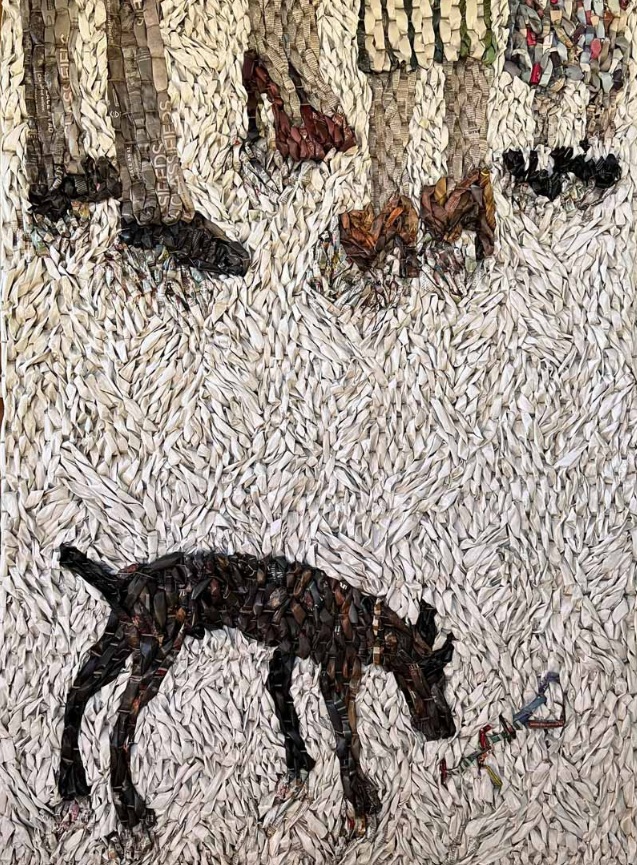
Gugger Petter, Dog with 3 People and Child, mixed media: woven newspaper, 62″ x 45″
Alice Leora Briggs has created works honoring the stray dogs of Juárez, Mexico, perhaps most movingly in her sgraffito, Perro Abandonado.
She relates, “In 2008, I arrived at Border Art Residency in La Union, New Mexico. I lived in a refurbished cotton gin 30 minutes from Paso Del Norte, a bridge that arches between El Paso, Texas, and Juárez, Mexico. Every other day I traveled to Juárez, trembling and bumbling, trying to understand what occurs when a president sends soldiers and federal police agents to occupy a city.
“When I remained north of the border, I rode my bike through the chile fields and pecan orchards of Mesilla Valley. One October morning, I rounded a curve about a mile from BAR. A jumble of a dozen tires had been thrown by the roadside. A dog, perhaps a shepherd mix, had also been discarded. It lay rotting beneath one of the tires. A thick belt still circled its neck. I rode by this horror about once a week, watching its body sink into the earth. Possibly no human being ever embraced this little dog, but it seemed as though the New Mexico ground tenderly held it in soft grasses and wildflowers.
“As I was leaving BAR in early summer 2009, I collected what remained of the dog, a scattered constellation of bleached bones. I’ve carried them with me from New Mexico to Texas to Arizona. They now reside in my Tucson studio.
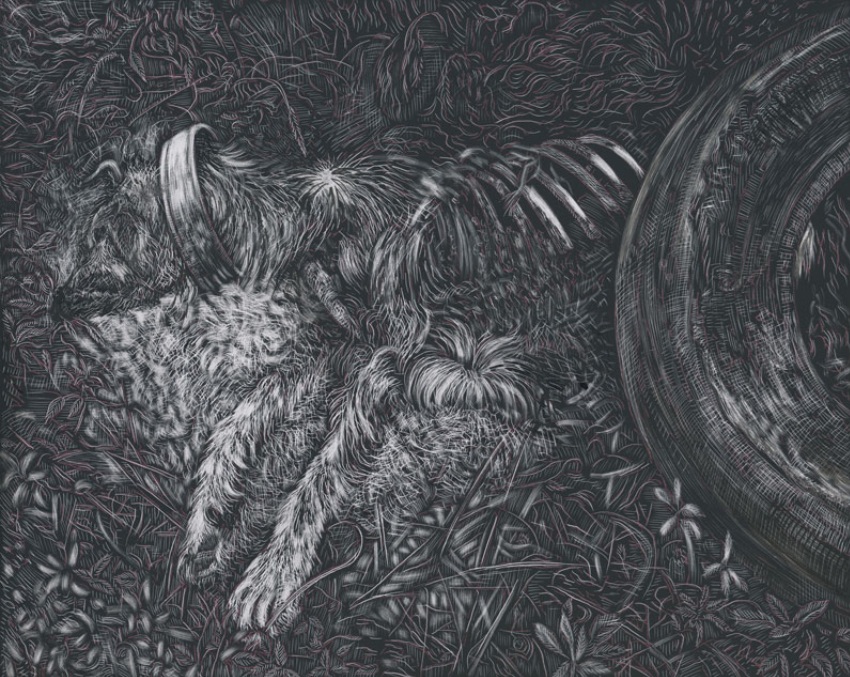
Alice Leora Briggs, Perro Abandando, sgraffito on panel, 8″ x 10″.
“When a pandemic arrived, the abandoned dog called my name. It was time. I drew Perro Abandonado, a forgotten dog that I still remember.”
When I asked Patrick McGrath Muñiz about the greyhounds in his painting, Lazarus Senex, he said, “They are inspired by greyhounds, but honestly most of the dogs I paint come from street dogs and mutts I’ve photographed in El Salvador and Puerto Rico. Some happen to look like greyhounds, maybe that already says something about which dogs are best equipped to survive out there on their own.”
In the Biblical parable of Lazarus, Luke writes that Lazarus was covered in sores and dogs came to lick the sores. Patrick notes, “Because of their watchfulness and fidelity, the dog has been accepted as a symbol of these virtues. . . Dogs have been with us since before cities, before agriculture. They remind us that we’re still raw, organic animals who need to go outside, take a walk, and reconnect with the real world.
“Art history is full of them, too. They’re never just decoration; they always point to something deeper about loyalty, mortality, or the human condition. I see myself working within that lineage, but with dogs that come from my own lived experience and surroundings. In an age where A.I. and algorithms are becoming more and more central to our lives, I sometimes wonder if we’ll end up in the position of dogs, dependent on and clueless about the intentions of a system much smarter than us. Maybe I paint them often because they bring us back to simple truths we’d otherwise overlook. They’re reminders to ‘log off’ and be human again.”
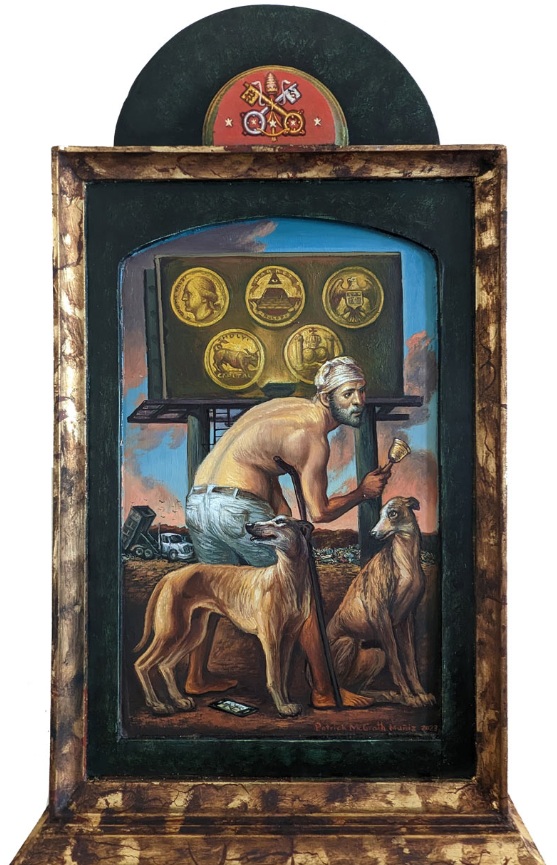
Patrick McGrath Muñiz, Lazarus Senex, oil and metal leaf on panel, 33″ x 12″