
STATEMENT
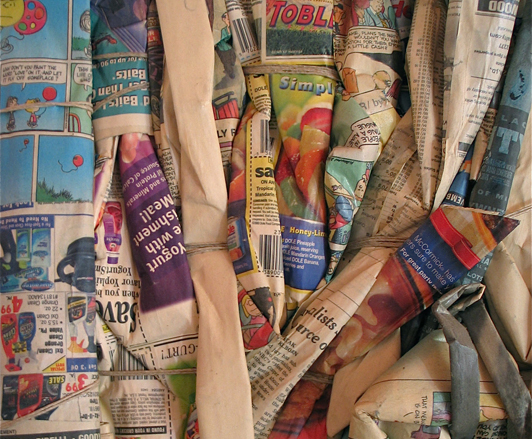
When I arrived to the West Coast in 1986, I saw how the California sun had yellowed and patinated a stack of newspaper on a sunny deck, I found this yellowing of material quite interesting. From this point I started to reflect on how I possibly could use this material. I found that by rolling the paper in tubes I could create units and manipulate them into 3D forms – creating both wall and floor sculptures. A couple of years later I started to construct 2D works by the use of a weaving technique. It all evolved quite fast, I managed to control the newspaper and transform it from a fragile to a strong material.
The most difficult thing working with newspaper is actually what makes this material most interesting to me. I have always been inspired by challenge, so when I decided to work with newspaper, it was due to the limitations/difficulty this material presented – both in regard to color palette and fragility. My manipulation of the tubes makes my work very strong, and the color limitation is a challenge that inspires me for each work I create. If I one day no longer find newspaper challenging as a material, I would no longer work with it. But so far I am very inspired by newspaper, and I also love the information aspect of newspaper.
Years ago I learned the basic organization and setup of tapestry weaving. By experimenting with the material and technique, I was able to create a workable basis for the construction of my newspaper works. I do not follow any rules for the craftsmanship of weaving. Instead I invent my own technique that works for me and my material. All my works are original, from the selection and use of material to the construction and weaving of the material.
I find the informative aspect of newspaper quite important. Since each piece I create holds all the world/local news of that particular time frame, it becomes an historic piece itself. All artists date their oeuvre with great importance – reflecting their moment in time. My works not only hold a date, they also represent an historic documentation of our lives. This information may not be of importance to the viewer, but for me each piece becomes a diary.
My work is most often based on an oversized image, where the line between abstraction and representation of image is slightly blurred, and where surface, subject matter, color and content all convey tension between opposites. I think most people view my works as “weaving-paintings”. At first view my works are perceived as paintings, but with a closer look they are surprised that the material is newspaper.
GUGGER
STATEMENT
When I arrived to the West Coast in 1986, I saw how the California sun had yellowed and patinated a stack of newspaper on a sunny deck, I found this yellowing of material quite interesting. From this point I started to reflect on how I possibly could use this material. I found that by rolling the paper in tubes I could create units and manipulate them into 3D forms – creating both wall and floor sculptures. A couple of years later I started to construct 2D works by the use of a weaving technique. It all evolved quite fast, I managed to control the newspaper and transform it from a fragile to a strong material.
The most difficult thing working with newspaper is actually what makes this material most interesting to me. I have always been inspired by challenge, so when I decided to work with newspaper, it was due to the limitations/difficulty this material presented – both in regard to color palette and fragility. My manipulation of the tubes makes my work very strong, and the color limitation is a challenge that inspires me for each work I create. If I one day no longer find newspaper challenging as a material, I would no longer work with it. But so far I am very inspired by newspaper, and I also love the information aspect of newspaper.
Years ago I learned the basic organization and setup of tapestry weaving. By experimenting with the material and technique, I was able to create a workable basis for the construction of my newspaper works. I do not follow any rules for the craftsmanship of weaving. Instead I invent my own technique that works for me and my material. All my works are original, from the selection and use of material to the construction and weaving of the material.
I find the informative aspect of newspaper quite important. Since each piece I create holds all the world/local news of that particular time frame, it becomes an historic piece itself. All artists date their oeuvre with great importance – reflecting their moment in time. My works not only hold a date, they also represent an historic documentation of our lives. This information may not be of importance to the viewer, but for me each piece becomes a diary.
My work is most often based on an oversized image, where the line between abstraction and representation of image is slightly blurred, and where surface, subject matter, color and content all convey tension between opposites. I think most people view my works as “weaving-paintings”. At first view my works are perceived as paintings, but with a closer look they are surprised that the material is newspaper.
GUGGER
STATEMENT
When I arrived to the West Coast in 1986, I saw how the California sun had yellowed and patinated a stack of newspaper on a sunny deck, I found this yellowing of material quite interesting. From this point I started to reflect on how I possibly could use this material. I found that by rolling the paper in tubes I could create units and manipulate them into 3D forms – creating both wall and floor sculptures. A couple of years later I started to construct 2D works by the use of a weaving technique. It all evolved quite fast, I managed to control the newspaper and transform it from a fragile to a strong material.
The most difficult thing working with newspaper is actually what makes this material most interesting to me. I have always been inspired by challenge, so when I decided to work with newspaper, it was due to the limitations/difficulty this material presented – both in regard to color palette and fragility. My manipulation of the tubes makes my work very strong, and the color limitation is a challenge that inspires me for each work I create. If I one day no longer find newspaper challenging as a material, I would no longer work with it. But so far I am very inspired by newspaper, and I also love the information aspect of newspaper.
Years ago I learned the basic organization and setup of tapestry weaving. By experimenting with the material and technique, I was able to create a workable basis for the construction of my newspaper works. I do not follow any rules for the craftsmanship of weaving. Instead I invent my own technique that works for me and my material. All my works are original, from the selection and use of material to the construction and weaving of the material.
I find the informative aspect of newspaper quite important. Since each piece I create holds all the world/local news of that particular time frame, it becomes an historic piece itself. All artists date their oeuvre with great importance – reflecting their moment in time. My works not only hold a date, they also represent an historic documentation of our lives. This information may not be of importance to the viewer, but for me each piece becomes a diary.
My work is most often based on an oversized image, where the line between abstraction and representation of image is slightly blurred, and where surface, subject matter, color and content all convey tension between opposites. I think most people view my works as “weaving-paintings”. At first view my works are perceived as paintings, but with a closer look they are surprised that the material is newspaper.